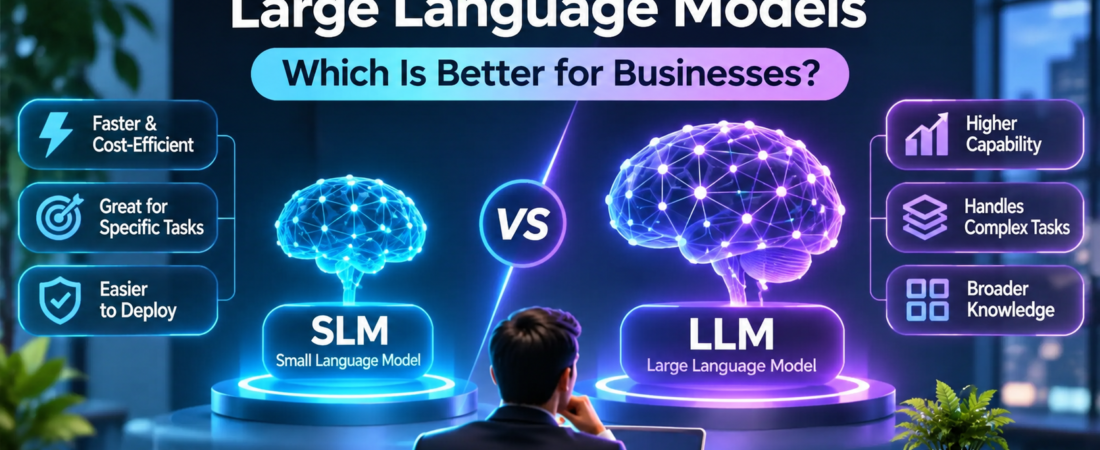
Artificial intelligence is transforming business operations, but choosing the right AI model is becoming increasingly complicated. Small language models and large language models are two major approaches, each offering different advantages in performance, cost, and flexibility.
Understanding the differences between SLM vs LLM technologies can help businesses make informed decisions about automation, data processing, and AI adoption.
But does a bigger AI model always deliver better results? Not necessarily.
What Are Small Language Models and Large Language Models?
Small language models (SLMs) are compact artificial intelligence systems designed to process and generate human language while using relatively limited computing resources. They generally contain fewer parameters than large language models, making them suitable for focused tasks.
Large language models (LLMs), on the other hand, are typically trained on broader datasets and often contain significantly more parameters. They can handle complex conversations, detailed analysis, creative writing, and diverse language-based tasks.
Both technologies rely on machine learning, but their computational requirements and typical applications differ considerably.
For businesses, understanding these differences is important because the most powerful model is not necessarily the most practical choice.
Key Differences Between SLMs and LLMs
The comparison between small language models and their larger counterparts involves several important factors.
Performance, Cost, and Computing Requirements
Processing speed: Smaller models often deliver faster responses for straightforward tasks, particularly when running locally. Larger models may require more computational resources, although actual speed depends on the infrastructure.
Operational costs: SLMs generally consume less memory and computing power, potentially reducing operating expenses. LLMs often require more substantial infrastructure.
Task complexity: Large language models typically perform better across unfamiliar subjects and demanding reasoning tasks. Smaller models can perform competitively on specialized tasks when properly trained.
Customization: Businesses can adapt either model type to particular applications. However, compact models may be easier to deploy in environments with limited resources.
These differences explain why companies increasingly consider model efficiency alongside overall capability.
Which AI Model Is Better for Businesses?
The answer depends on business requirements rather than model size alone.
Small language models can be suitable for routine document classification, basic customer inquiries, information extraction, and other clearly defined processes.
Large language models are often better suited to complex research, detailed document analysis, advanced reasoning, and tasks requiring broader language understanding.
For example, a small company processing hundreds of standardized customer requests might benefit from a specialized SLM. An organization analyzing complicated legal documents may require a more capable language model, alongside appropriate human review.
Importantly, neither model type guarantees accurate or secure results.
Can Small and Large Language Models Work Together?
Businesses do not always need to choose between SLMs and LLMs. A hybrid approach can combine their strengths.
In such systems, smaller models handle simpler requests, while larger models process tasks requiring more advanced reasoning. This approach can improve resource efficiency without sacrificing capabilities where they are genuinely needed.
These models may also support autonomous business workflows.
Read our related article: Agentic AI Explained: How It’s Changing the Future of Work to explore how intelligent agents coordinate tasks and make decisions.
However, combining multiple AI models introduces additional challenges involving security, monitoring, and data management.
The Future of Small Language Models and LLMs
Advances in artificial intelligence are making both model categories increasingly capable and efficient.
Small language models are becoming more practical for specialized applications, while larger models continue to push the boundaries of complex language understanding.
Ultimately, the SLM vs LLM decision should depend on accuracy requirements, operating costs, privacy considerations, and the complexity of business tasks.
For many organizations, the future may involve using both technologies together rather than treating them as competing alternatives.