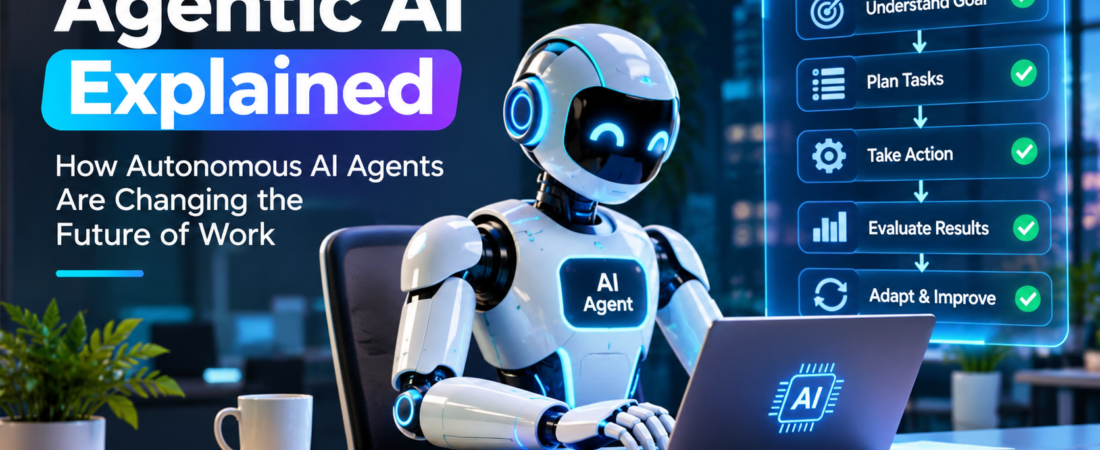
Artificial intelligence is no longer limited to answering questions, generating content, or analyzing information. A new development, known as agentic AI, is changing how technology handles complex tasks by allowing AI systems to make decisions, plan actions, and work toward specific goals with limited human intervention.
Unlike conventional AI systems that rely heavily on individual instructions, autonomous AI agents can manage multiple steps within a workflow. This shift could significantly change how businesses operate, how employees work, and how organizations approach automation.
What Is Agentic AI?
Agentic AI refers to artificial intelligence systems capable of independently planning and executing tasks to achieve a defined objective. Instead of simply responding to commands, these systems can assess situations, determine appropriate actions, and adjust their approach when circumstances change.
The key difference is autonomy. While conventional generative AI primarily produces responses, agentic AI focuses on completing tasks through a sequence of decisions and actions.
How Do Autonomous AI Agents Work?
Autonomous AI agents combine reasoning, planning, memory, and access to external systems to complete tasks. Their operations typically involve several connected stages.
The Decision-Making Process Behind AI Agents
The process begins when an agent receives a goal. It then analyzes the requirements, divides the objective into smaller tasks, and determines how to complete them.
During execution, the agent may retrieve information, interact with authorized systems, evaluate results, and modify its plan when necessary.
For instance, an AI agent assigned to monitor inventory could identify declining stock levels, analyze previous demand, and prepare recommendations for replenishment.
However, autonomous does not mean completely independent. Human-defined permissions, operational boundaries, and supervision remain essential, particularly when decisions have financial or security implications.
The reasoning capabilities of these systems also depend on their underlying AI models. Read our related article: Small Language Models vs Large Language Models: Which Is Better for Businesses? to understand how different model architectures influence AI capabilities.
How Agentic AI Is Transforming the Workplace
One of the most significant applications of agentic AI is workplace automation. Organizations increasingly need systems capable of managing complicated processes rather than simply performing repetitive actions.
In administrative operations, autonomous agents can help organize information, coordinate schedules, and monitor ongoing workflows. In customer support, they can assist with categorizing requests, retrieving relevant information, and escalating complicated issues.
Similarly, financial and operational departments can use agentic systems to identify unusual patterns, reconcile records, and prepare information for decision-makers.
These capabilities may reduce time spent on routine coordination, allowing employees to focus on strategic planning, creativity, and complex problem-solving.
Smaller organizations may also benefit from this technological shift. Read our related article: How Artificial Intelligence Is Transforming Small Businesses in 2026 for a closer look at AI’s growing role in business efficiency and everyday operations.
Benefits and Challenges of Agentic AI
The potential advantages of agentic AI include improved productivity, faster information processing, and greater flexibility in business operations.
Unlike rigid automation, which typically follows predefined instructions, agentic systems can adjust their actions based on changing information.
Nevertheless, this flexibility introduces risks. AI agents may misinterpret objectives, produce inaccurate results, or take inappropriate actions if their permissions are poorly configured.
Data security is another major concern, especially when autonomous systems interact with confidential business information.
Read our related article: AI Privacy and Data Security: What Happens to the Information You Share With AI Tools? to explore the security challenges associated with increasingly autonomous AI systems.
The Future of Agentic AI
Agentic AI represents an important step toward more adaptive and independent artificial intelligence systems. As the technology develops, autonomous agents could become increasingly involved in coordinating complex business processes, supporting research, and managing operational tasks.
However, successful adoption will depend on reliability, transparency, and meaningful human oversight.
Rather than eliminating human involvement, the future of agentic AI is likely to involve collaboration between people and intelligent systems, with humans setting objectives, exercising judgment, and maintaining accountability for important decisions.